Posted in Misc.

The ‘White’ Literacy

Image result for white literature

It has been many, many months since I began this blog as part of my Writing in the Public Sphere class. I have thought of it many times, and often considered putting up another post. I always struggled with what I could write, though. Mental Health in schools is an issue near and dear to my heart, but I had not been doing a lot of work in that area. So, my blog sat untouched since posting my final project for the course. Until now.

What follows is a writing assignment for my current class, Literacy and Writing Studies. The prompt asked us to think about literacy in our own lives and draft a narrative that explored our relationship with that literacy in order to make an overall point. As I am sure you can guess by my reappearance on this blog, my overall point involves mental health. It is a bit more round-a-bout than my usual posts, but still there and still important. So, without further ado, my literacy narrative:
Related image

My senior year of high school, I was a volunteer for a trial program that my school counsellors were attempting to implement. My classmates and I would meet with students from the grade below us periodically throughout the year and guide them through the process of choosing a college and applying. At the start of the first meeting, I was sitting next to my friends, some of whom I had known since first grade, all of whom attended at least one AP class with me, talking excitedly about this program and college in general. The counsellors and student leaders in charge of the program got everyone settled down, and us seniors proceeded to stand up, one by one, and state our major and the name of the college we were to attend. Lillian was attending CSU Long Beach. Faye was going to UC Santa Barbara. Redlands University. UCLA. UC Davis. Cal Poly San Luis Obispo. San Diego State. Montana State University, which was particularly exciting to me because I had applied and been accepted there. The list continued, all of my friends proudly declaring where they would be next year. Then it was my turn. I stood up and said “I am going to be an English major at Victor Valley College.” I never attended another meeting. I have no idea if the program continued after that, but I was never informed that my presence was needed as a mentor. 

My college of choice was a junior college, a two-year institution that awarded associates degrees, rather than a more ‘prestigious’ four-year institution for bachelors. It was quite astounding, the response to my chosen path. My high school had a direct transfer set up between them and Victor Valley, but I can count on one finger the number of times that pathway was mentioned throughout my four years as a high school student. Four year universities were the only acceptable schooling option, and the fact that I was going to a community college was something I should have been embarrassed about, not proud of. The money I was saving in tuition and housing was not a consideration, nor was my emotional state regarding how prepared I was for the drastic change going to university would be. The only thing that mattered was the prestige of four full years.

This was just one of many instances in which my school and the people I trusted to guide me limited the information available to what they deemed acceptable. At the time, it had seemed like my school was progressive and open with its students. I had a teacher with two full sleeves of tattoos. Another teacher regularly talked about his past as a “hippy,” including some drug use. In class, I was allowed to do a project on what I considered to be a very immoral and honestly quite twisted book (A Clockwork Orange by Anthony Burgess). These were topics that seemed radical to my younger self. They really weren’t. The school followed the canon. Every piece of literature we ever read at my school was created by a white author from an approved list of those deemed acceptable. I was completely unaware of the incredible diversity of literature until I reached college. Up until then, I had never come in contact with Black literature, Indegenous Peoples literature, or Latinx literature. I was only ever taught ‘academically acceptable’ literature.

Related image

Winn, et al. claim that “by being offered only one version of literacy, students are in effect denied literacy,” (151). The denial of literacy, according to them, is a denial of a civil right. By limiting the knowledge to what was deemed important, entire genres, entire cultures were silenced and kept from us. We may have learned to ask questions about white concerns, but we never learned that there were other issues in the world. We never learned what questions we should be asking, only what questions they prompted us to ask. We trust our schools to educate us and teach us the literacies we need to survive in the world, but the current school system really struggles to fulfill that promise. My school was excellent at conveying academic literacy, but they did not offer anything else. Without that ‘anything else,’ I was really struggling. 

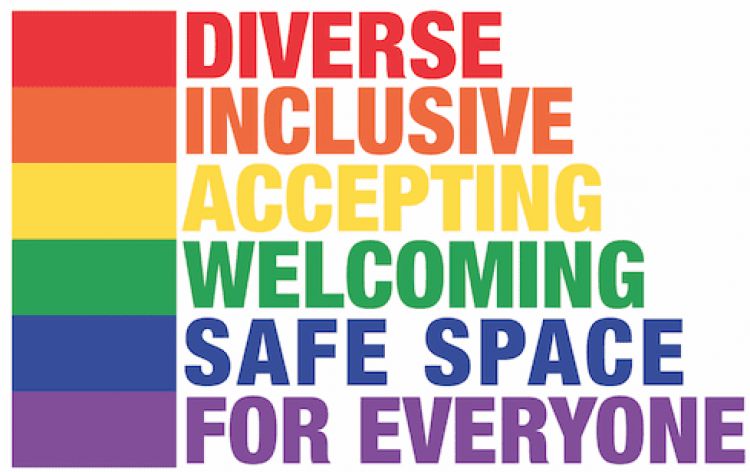
In June of 2016, weeks after I graduated from my “progressive” high school, my group chat of fellow readers/writers finally convinced me to try a new genre of books. Him by Sarina Bowen is basically just smut with a little plot thrown in, but at the time, it was a revelation. I fell in love with this book and its sequel. I fell in love with the entire LGBTQ genre. Today, having reread this book several times, I cannot point to a specific part of the book and say “this is why everything changed.” All I know is that everything did change. Over the coming years, my pleasure reading would transition to exclusively LGBTQ novels. During this time, my vocabulary expanded exponentially. Everyone knows “gay” and “lesbian.” A lot of people know “bisexual.” My reading taught me pansexual, and panromantic. Asexual. Graysexual. Transgender. Transexual. Genderqueer. Agender. Nonbinary. Suddenly I had names for things I had never even considered before. I was familiar with concepts that I didn’t even realize were possibilities. I was familiar with the various genders, the multiple sexualities, and the overlap between all of them. I was exposed to an entirely new literacy surrounding the concept of queer and with it came the recognition of an entirely new culture in which I started to see myself. 

It was finally seeing myself in those pages that allowed me to realize how truly damaging my high school experience had been to me, especially in those delicate developmental years. I had no idea where my place in the world was, was struggling terribly as I searched for it, and I was not finding it in the literature we were reading or the conversations we were having. If I, as a white person, struggled to connect with literature about white populations that felt so far removed from my life, I can only imagine what it must have been like for my classmates. Latinx, Asian, Black, Native American: my classmates were a diverse bunch, stifled into reading a very limited selection of literature. We were all trying to find our places in the world, and our school was showing us only one possibility of the endless possibilities that exist. They did not consider anything else to be important, and because of that, I, and I am sure many of my classmates, were completely unprepared for how vast and diverse the world really was. I was completely overwhelmed, and still deal with the anxiety that stemmed from that sense of displacement despite finding some grounding in my queer identity.

High school and college is the time when most people really start to discover who they are. They build their identities based off of their experiences and their ideas about who they want to be. That is not easy to do when the only reference they have is someone who looks nothing like them, who acts nothing like them, who is completely removed from their lives. Literature should enable people, not hinder them. Reading let me discover a huge part of who I am. It allowed me to learn and become a part of an entirely new culture that I otherwise had no contact with. Even now, my strongest connection to the queer culture is through literature. Acknowledging my place in queer society let me settle into my life in a way that I desperately needed. Without finding those books, and without learning about a whole new possible identity and culture, I cannot imagine what my life would be like. 

My school and the school system that it is based off (i.e. No Child Left Behind) was incredibly limiting and only allowed us to interact with the ‘white’ literature. They wanted us to learn only what they deemed to be the ‘right’ lessons. It is a concept that is incredibly short-sighted and damaging. It erased entire cultures and devalued the incredible diversity of its student-body. Diversity and multiplicity should be the focus of every school and every classroom. The world is a huge and diverse place, and schools should be preparing students for that, not limiting them to what they think is the ‘right’ (hear- ‘white’) way of life and academia. Finding my place in the world as a queer individual drastically changed my life from the mess of insecurities that my high school left me with. Introducing diverse literature and recognizing that there is more than one way to live and operate within and outside of academia should not be such a difficult task considering how incredibly diverse the world is today. Any erasure of culture should not be allowed, and especially not encouraged by the programs that control our schools and our childrens’ lives. 

Image result for rainbow human

Works Cited

Winn, Maisha T., et al. “The Right to Be Literate: Literacy, Education, and the School-to-Prison Pipeline.” Review of Research in Education, vol. 35, 2011, pp. 147–173. JSTOR, www.jstor.org/stable/41349015. Accessed 3 Feb. 2020.
Posted in Misc.

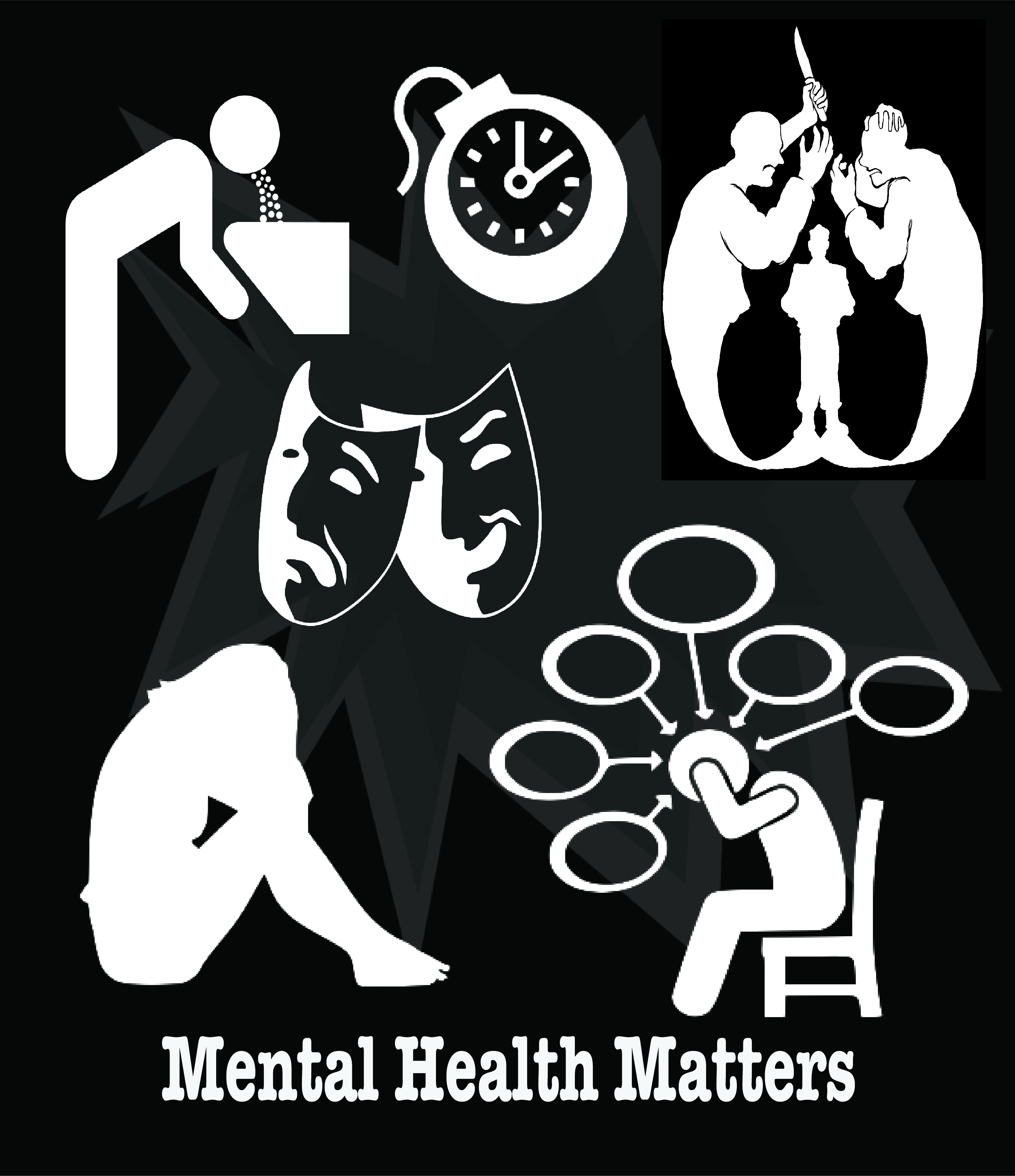
Mental Health Matters

Mental Health is an important aspect of our lives that really needs more consideration and acknowledgement than it is currently receiving.
The current methods of treating mental health, especially among school-aged people, are inaccurate and rely too heavily on medication.
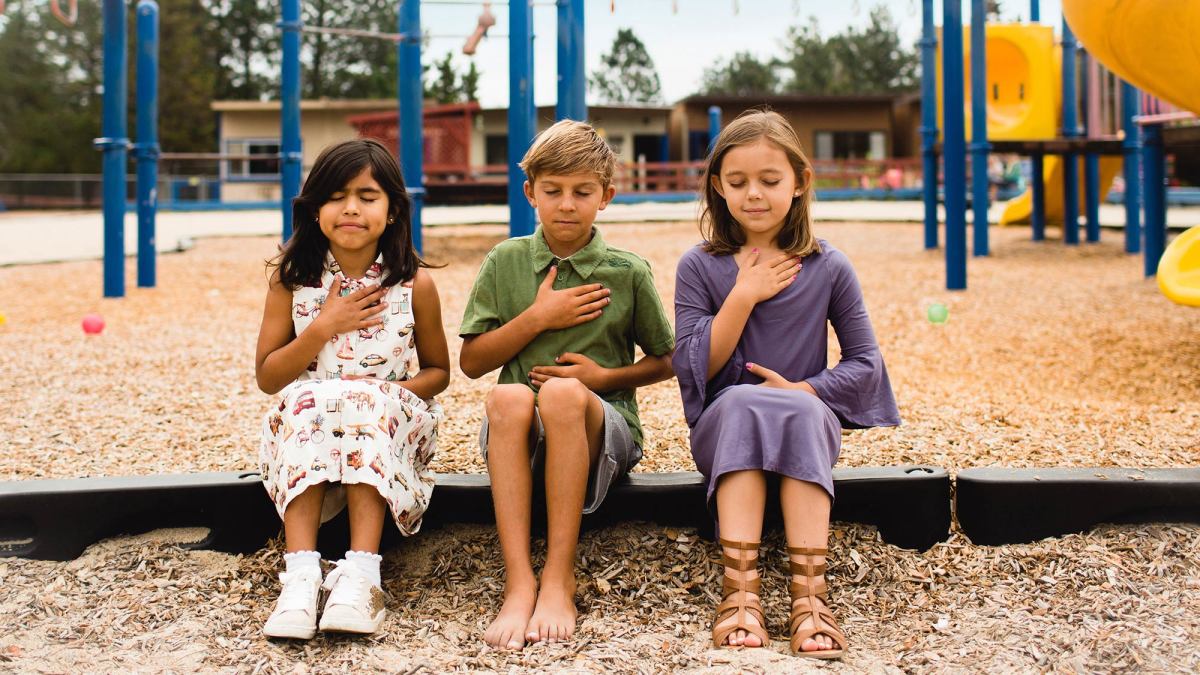
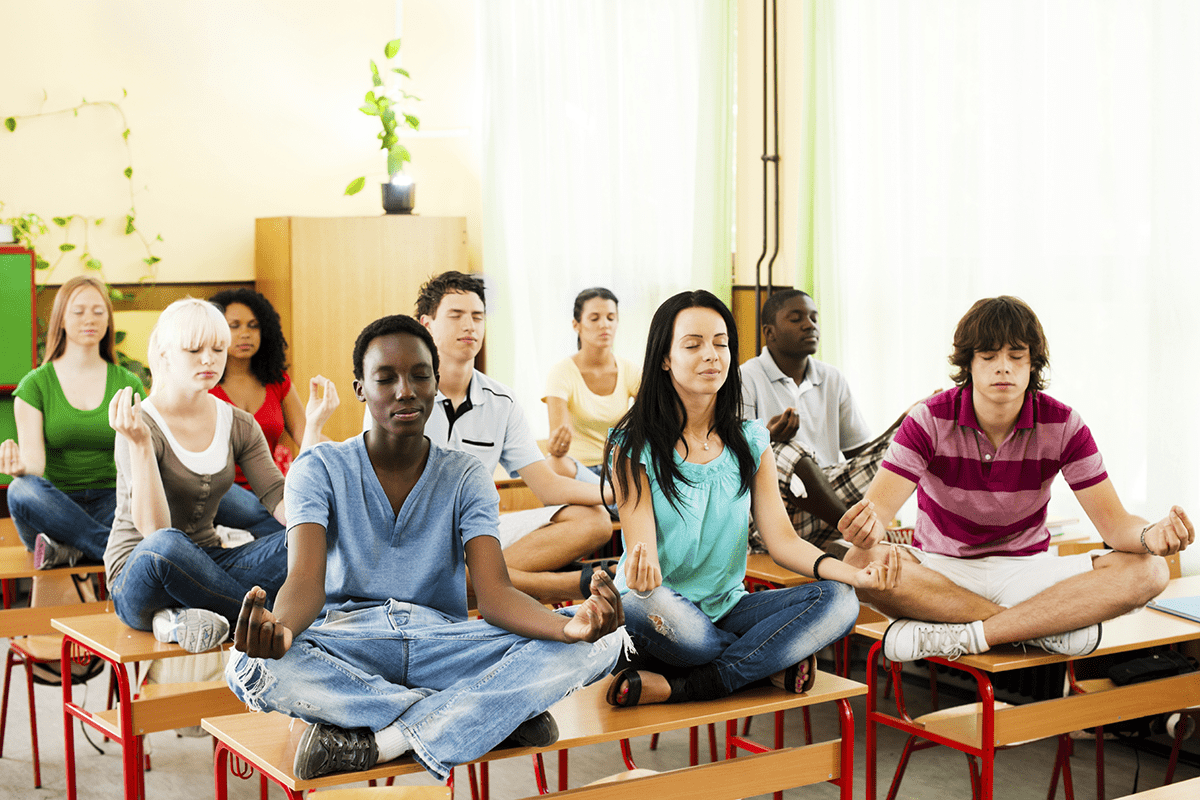
Certain activities such as yoga, meditation, mindfulness, or martial arts have been shown to have positive effects of mental health and well-being.
Incorporating the above mentioned activities into the school days will serve to address the stigma surrounding mental health and allow for more honest conversations and requests for help.
More open and honest environments will result in more accurate diagnosis and help for addressing mental health issues, leading to more balanced well-beings among school-aged people and beyond.
Posted in Research Journal

Issues with the Current System

Journal #3: Vulnerabilities in Treatment and Counseling Services

“Everything’s fine. There are no problems here.”

More than half of the public schools in the United States employ someone who oversees or coordinates school mental health and social services. More than three quarters of school districts have a stated policy of offering student assistance programs. These figures obtained from a peer-reviewed article entitled “Use of Treatment and Counseling Services and Mind-Body Techniques by Students With Emotional and Behavioral Difficulties” and written by Wasantha Jayawardene and company seems to convey the idea that public schools are making strides to assist students with mental health issues. They are acknowledging that mental health is an issue that needs addressing and that they hold some responsibility for addressing it.

That’s fantastic. It just does not do enough. An article I looked at previously offered the information that school-aged students are being inaccurately diagnosed and overmedicated to a startling degree. The students are not getting the proper help they need. The system as it stands is intrinsically flawed.

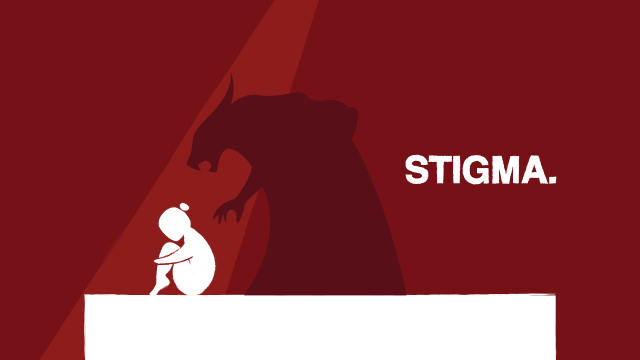
There is a stigma that exists, especially in public schools in the United States. Suffering from mental health issues is not something to be broadcast throughout the student body or even to adults. Kids are too often told to “man up” or “get their stuff together.” There is an unspoken rule to avoid asking for help for anything that happens inside one’s’ own head.

In order to improve the effectiveness of current treatment and counseling services offered by schools, this stigma needs to be addressed. The schools need to create a safe environment where students are able to ask for help without fear of reproach or other negative consequences. The counselors responsible for helping and diagnosing students need a safe environment where honest conversations can take place. If the student feels safe enough to be honest, the school’s personnel can come to a more accurate conclusion and get the students the help they actually need.

Posted in Reading Response

School Effectiveness & Possible Improvements

Reading Response #6: “Time in School: How Does the U.S. Compare?”

Jim Hull and Mandy Newport worked together to create a brief entitled “Time in School: How Does the U.S. Compare” which strives to answer the question do United States students spend less time in school than students in other countries? Published by the Center for Public Education, the article examines the claim made by U.S. Department of Education Secretary Arne Duncan during a congressional hearing which used data to assert that students in India and China attended school twenty-five to thirty percent longer than students in the United States. The claim was made in an effort to prompt a policy decision in favor of raising the minimum number of hours required by schools in the United States.

Hull and Newport’s article utilized data from the OECD (Organization for Economic Cooperation and Development), Education Commission of the States’, and the World Data on Education to develop the briefing. The time measurements were based on the countries’ compulsory hours, or minimum hours of instruction per year, allowing for some discrepancies in what countries consider instructional hours. India and China were considered to directly examine the claims made by U.S. Department of Education Secretary Duncan. Korea, Japan, Finland, Canada, England, France, Germany, and Italy were also examined in order to fully examine whether United States students were required to spend less time in schools than other countries.

The results were overwhelmingly against Secretary Duncan’s claims. India and China required less or about equal to the same number of hours as United States. The other countries repeated this pattern, often requiring less hours. Finland, one of the world’s top performers in education, actually had a minimum number of hours significantly smaller than the United State’s average and still less than Vermont’s minimum, which is the least amount of hours required of any state in the U.S.

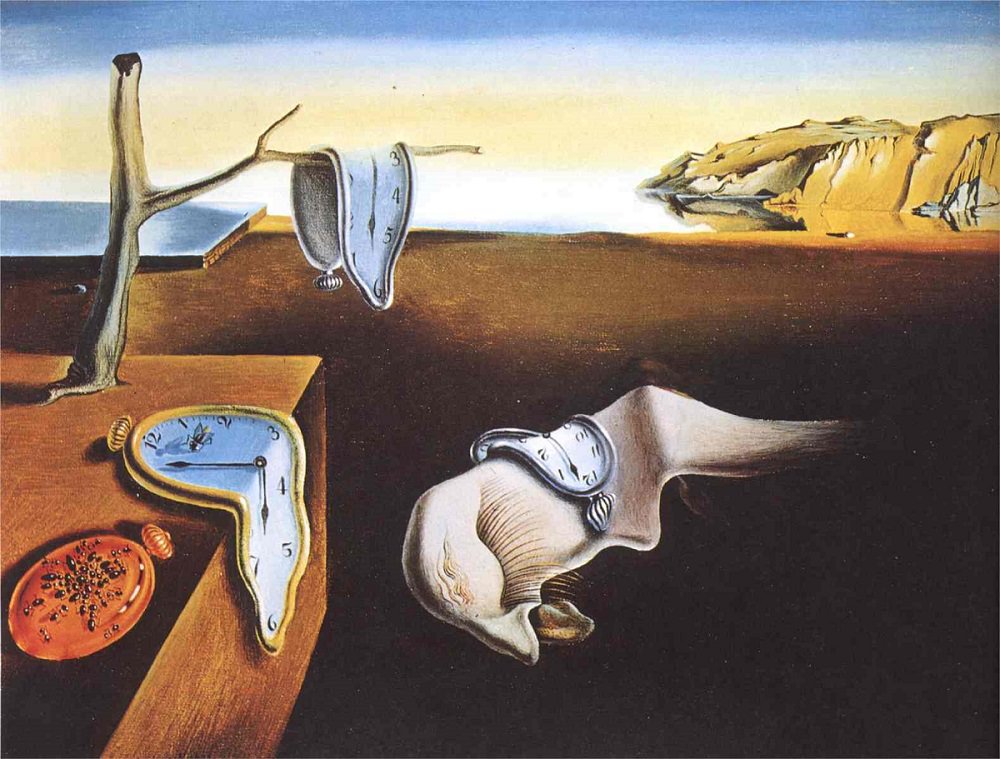
The Persistence of Memory – Salvador Dali

As a work in the public sphere, this briefing is a well done response to claims made by a public figure. U.S. Department of Education Secretary Arne Duncan made a claim, and the authors of this briefing, Jim Hull and Mandy Newport, made a reply in that they looked at Secretary Duncan’s claims and determined more explicitly the veracity of said claims. The briefing remains unbiased, clearly listing the source of its data and the method utilized. It also makes clear the limitations of its findings. The briefing also offers alternative methods to be considered in order to improve student effectiveness that does not include adding more hours to the minimum requirement.

The article is interesting in that it puts the United States public schools on a national scale and makes a comparison. The United States is fairly average in number of instructional hours required of students. Increasing the minimum would not create a more constructive educational system. Making students attend school longer would not make them better students. Instead, policy makers should consider alternative methods to increase effectiveness of students and instruction. The briefing lists a few ways to make the most of school time. I would encourage ways the schools could make the most of the students’ abilities. Mental health issues have been proven to be detrimental to student success, especially when they present as behavioral issues that disrupt entire classrooms. By addressing these concerns through various practices designed to better the current treatment and counseling systems indirectly, students would receive the help they need and their balanced well-beings would result in more effective learning. Students with balanced mental health would be more successful and less distracting, resulting in the improvement of school effectiveness desired by policy makers such as U.S. Department of Education Secretary Arne Duncan.

Posted in Research Journal

Mental Health Matters Project Outline

English 240 is called Writing in the Public Sphere. As befitting a class of that title, we learned about the wide varieties of literatures and medias that can be considered public literature and intended for the public consumption. For the final project, I decided to do a sequenced five-piece visual media project to really take advantage of the variety offered in public sphere writings. 

My main argument is that public schools in the United States need to adjust their treatment programs for mental health issues among their students. The current system is ineffective in reaching the student body and relies too heavily on medications. The adjustment I’m suggesting involves addressing the stigma surrounding mental health and seeking help by introducing various practices, such as mindfulness or yoga, which will expose students to practices that benefit mental health and reveal the importance of maintaining a balanced well-being. By exposing the students to this knowledge, they will be more willing to seek help themselves or encourage others to seek help. It will also improve current treatment and counseling services by creating a more open and honest environment in which more accurate diagnosis and treatment plans can be established. 

The visual media project will reflect these ideas. The first section will be dedicated to mental health, including the detrimental effects, thereby emphasizing its importance. The second section will include the issues currently surrounding treatment and counseling services, mainly inaccuracy of diagnosis and overmedication. The third section will address the school-wide attention and intervention strategies mentioned above. The fourth section will include a visual of the effect of the strategies of the previous section on addressing the stigma and allowing for more open communication. The fifth and final section will include a visualization of the effect addressing mental health concerns can have, including a balanced well-being. 

I am not an artist or a graphic designer, but I hope that by choosing the visual media for my project, I am able to demonstrate the accessibility of the public sphere and the truly wide array of medias introduced there. 

Posted in Event Reflections

50/50 Movement

Event #2: CSUSB’s 2nd Annual 50/50 Celebration

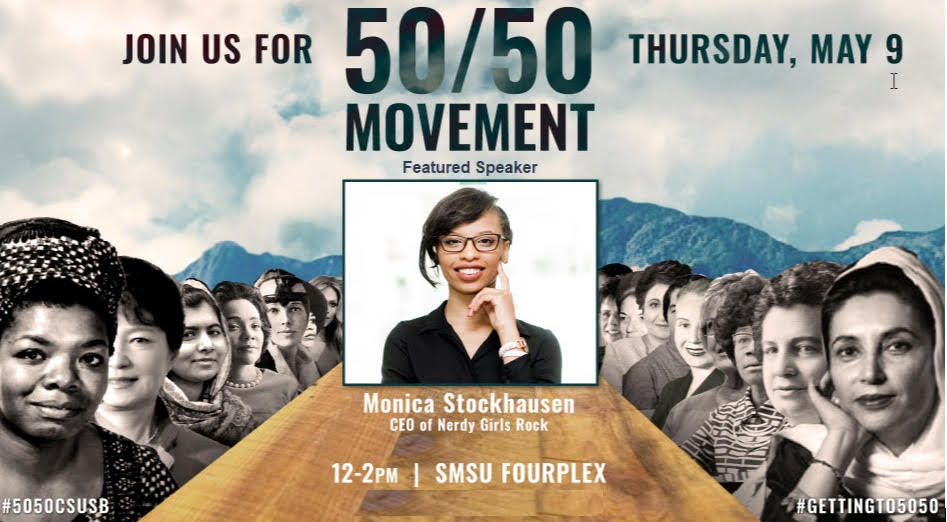
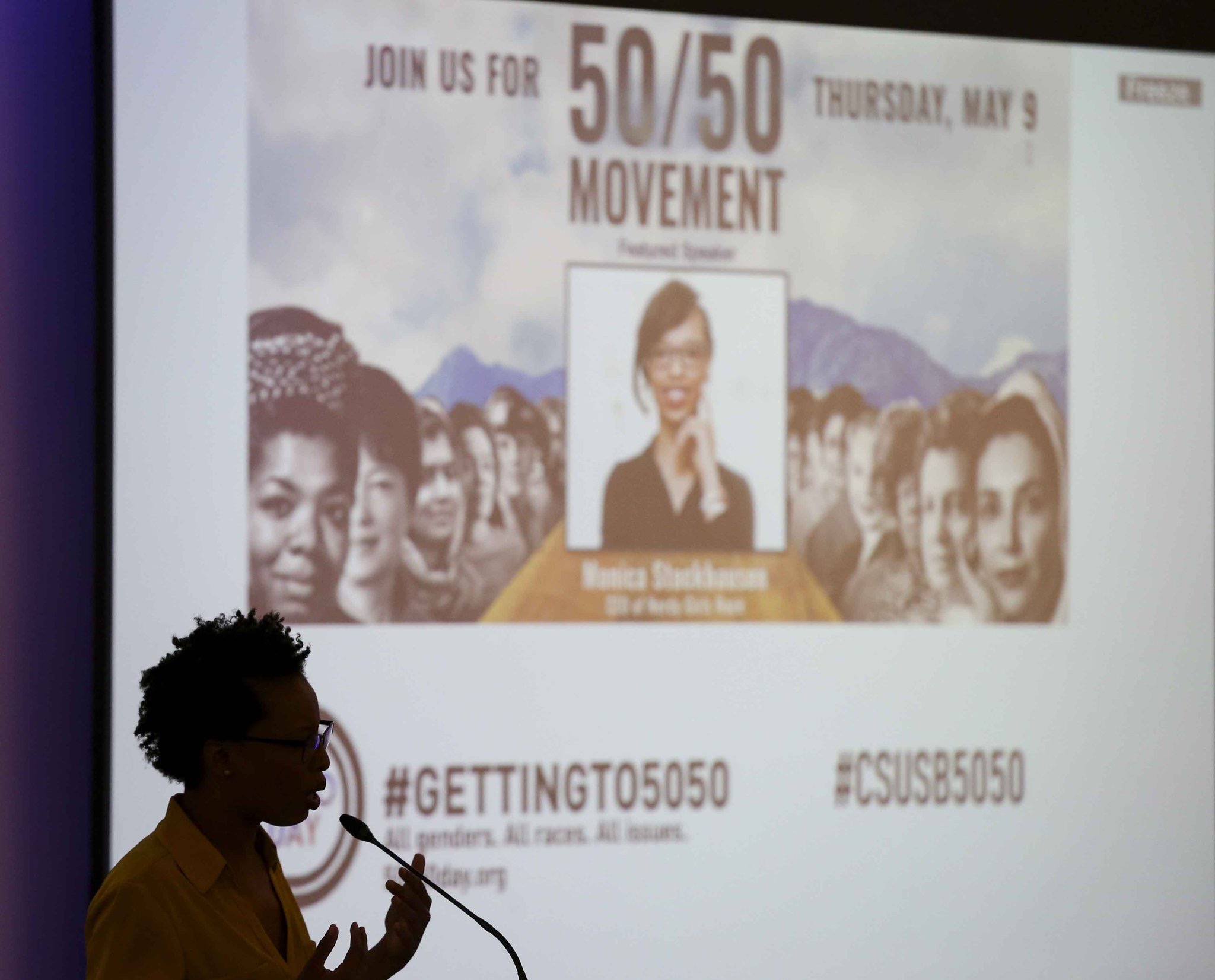
CSU San Bernardino held its second annual 50/50 Day celebration on Thursday, May 9th, 2019. Prior to the event taking place, emails were sent out to the student body advertising the event and posters were hung about campus. The posters featured the event’s featured speaker, Monica Stockhausen, and the emails also included an explanation of what 50/50 day was.

50/50 Day is a free day and global initiative for people to engage in conversation about working towards a more gender-balanced world in all sectors of society: business, politics, culture, home, and more. All this with one theme: #GettingTo5050, a gender-balanced world that’s better for everyone. All genders. All races. All ages. All issues. Participating groups view films: 50/50: Rethinking the Past, Present, and Future of Women in Power, which explores the 10,000 year history of women + power — from setbacks and uprisings, to the bigger context of where we are today.

The event offered preregistration, which took place online at eventbrite. Admission was free and registration prompted follow-up emails in the time leading up to the event which offered more information. The first follow-up email came from the university ten days after registration and included a check-in time and a map of the event location with “Lunch included” in the subject line. The next email came five days later from eventbrite and was a simple reminder notification.

On the day of the event, the campus was bustling as usual with students attending classes. Approaching the building showed very little signs of unusual activity. It was not until the second floor that a rare sign was posted to help guide students to the event center.

Check-in at the event included two tables arranged for check-in by the last name. One person checked a list and crossed off the name, the other looked for the identification badge. The table included “first time attendee” ribbons that could be attached to the badge as well as buttons advertising the event, and students were given free water bottles.

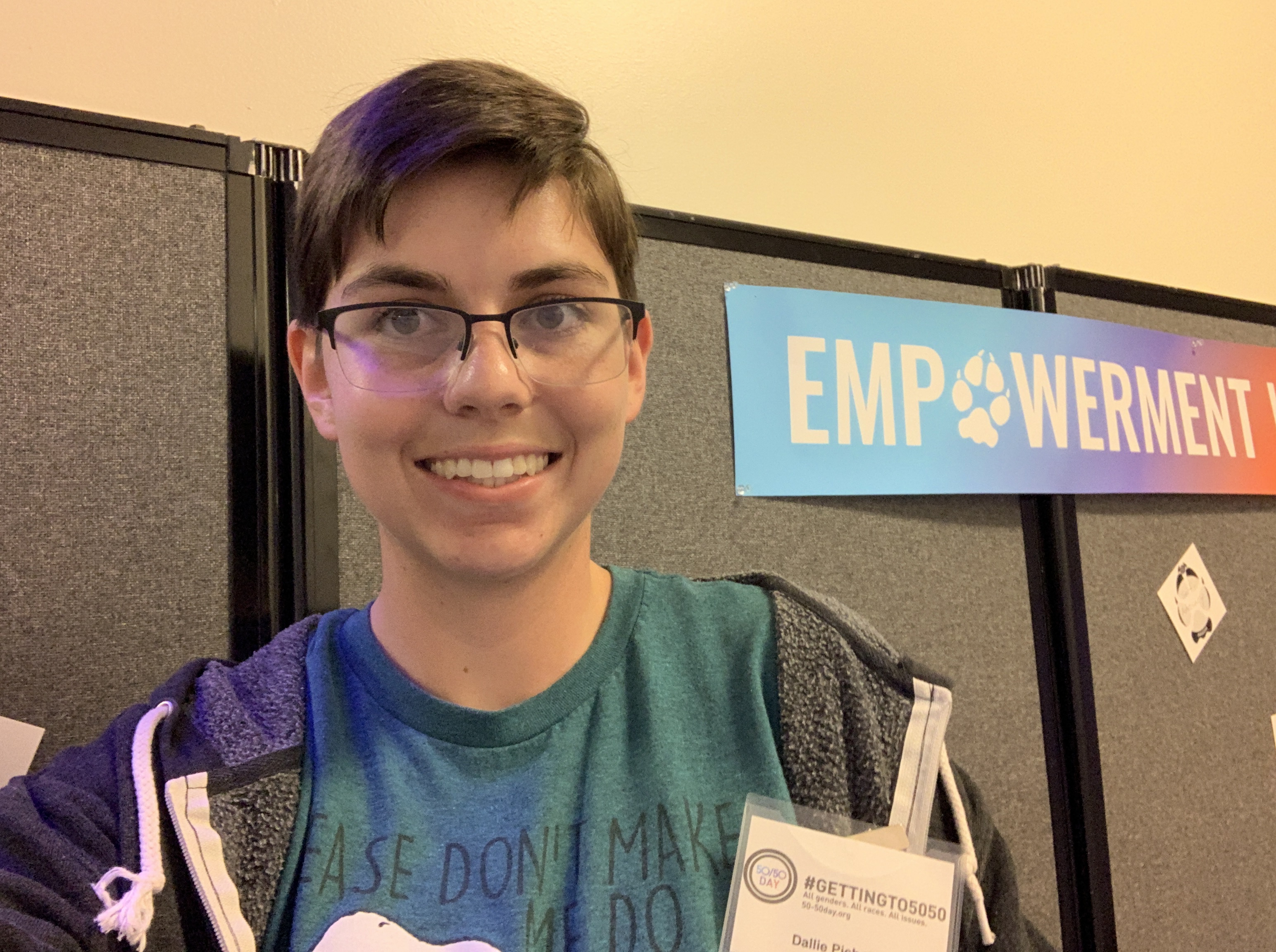
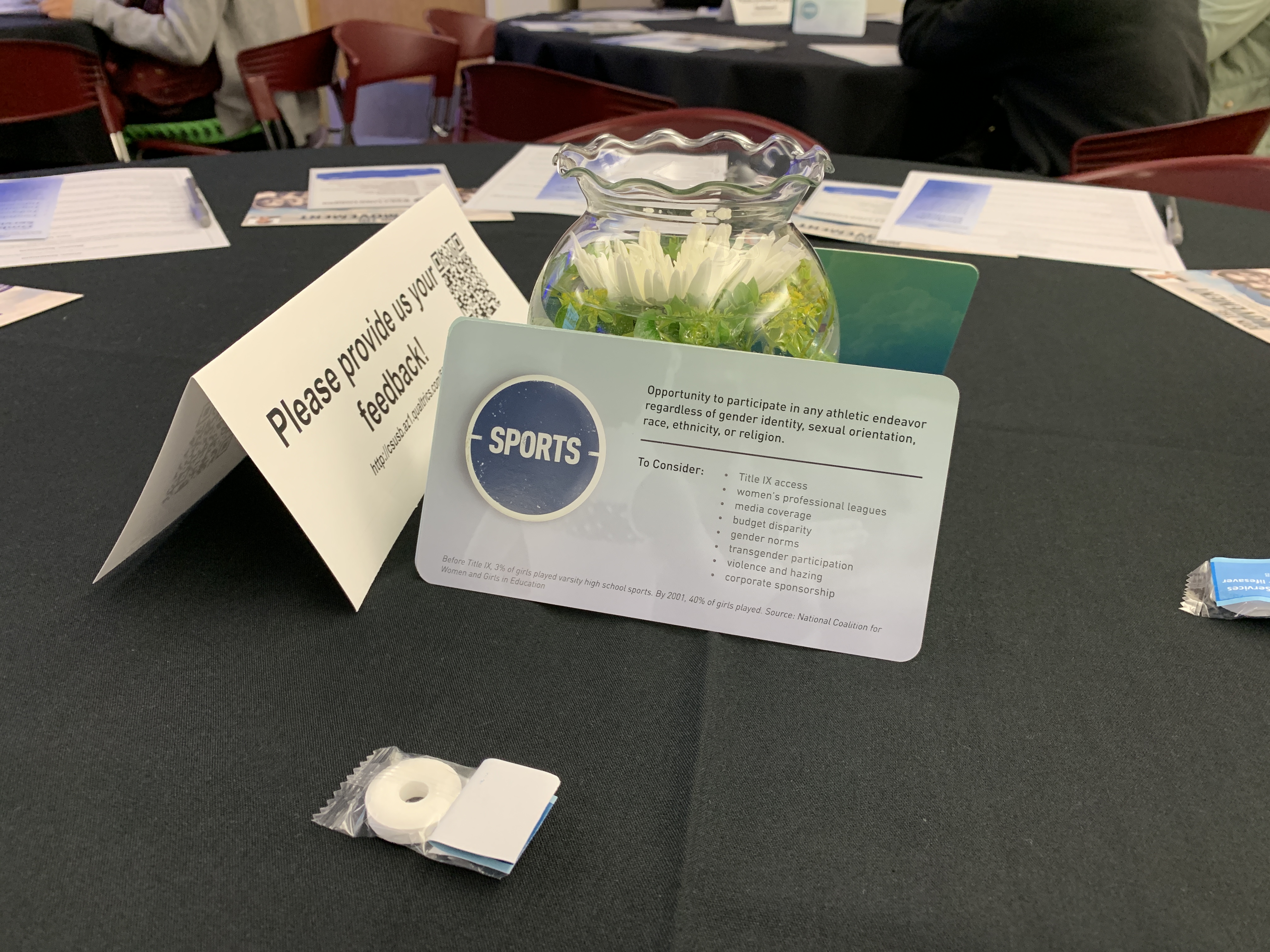
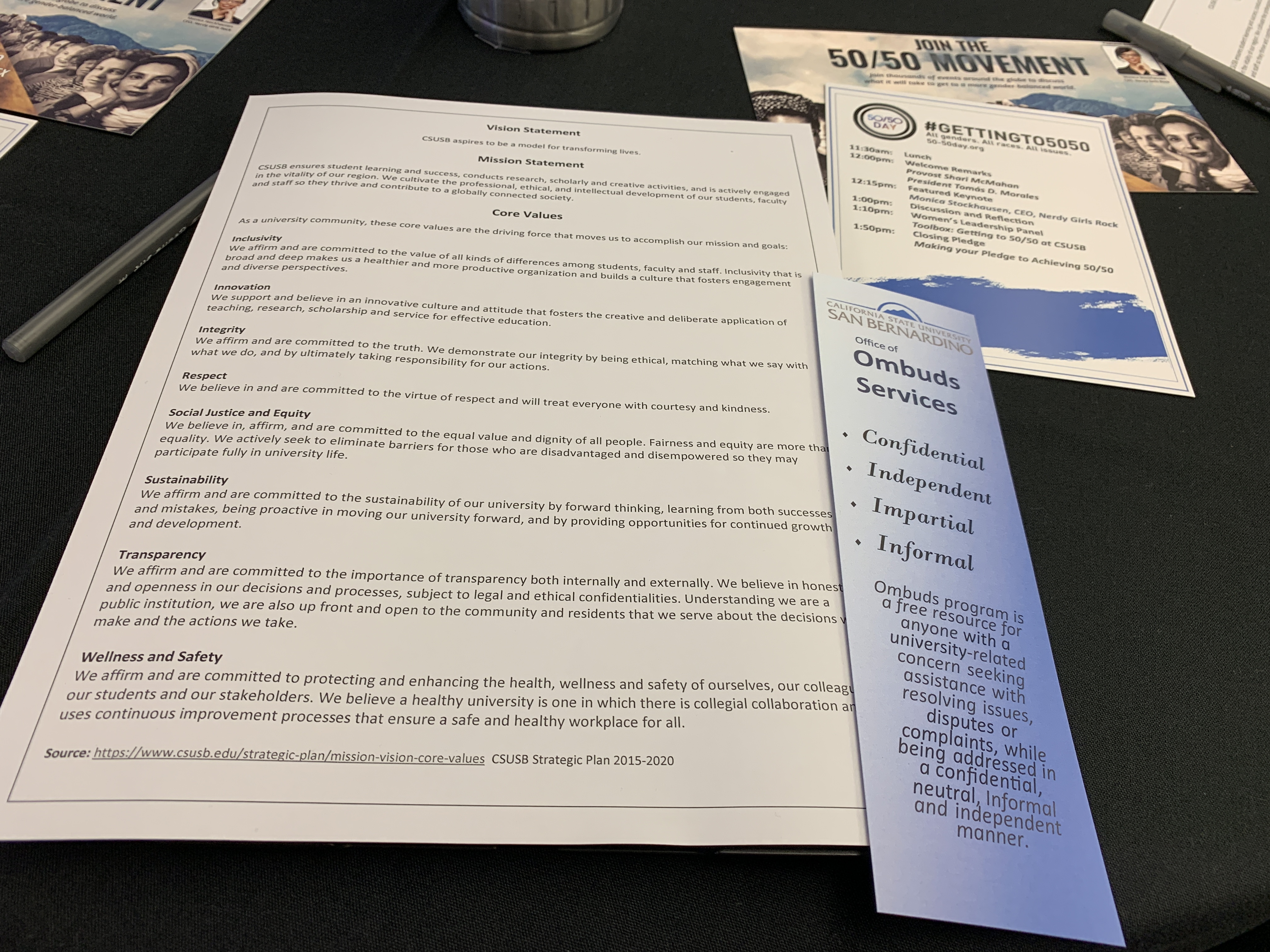
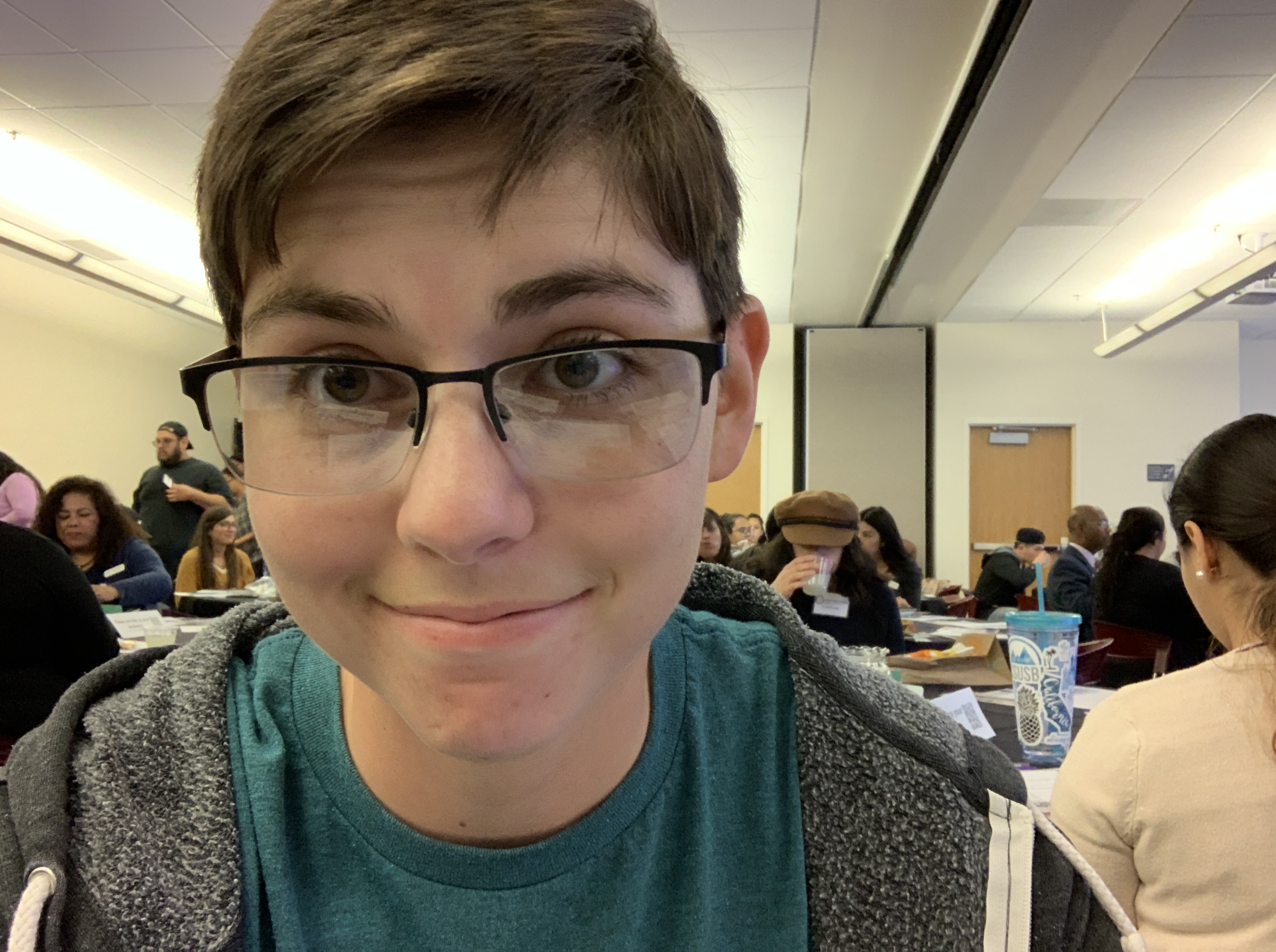
Walking into the actual event room was overwhelming. Round tables were set up throughout the room, covered with black tablecloths and adorned with a beautiful centerpiece. Each place setting included a mission statement, an Ombuds Services bookmark, an event schedule, and a 50/50 Movement postcard. A buffet was set up along the back, and a discussion panel table was at the front. There were four or five cameras set up in order to stream the event to the Palm Desert campus. I settled into a spot with another awkward, underdressed student and we joked about how unprepared we were for all the suits and the actual lunch. My selfie came with numerous silent apologies as I captured people eating in the background.

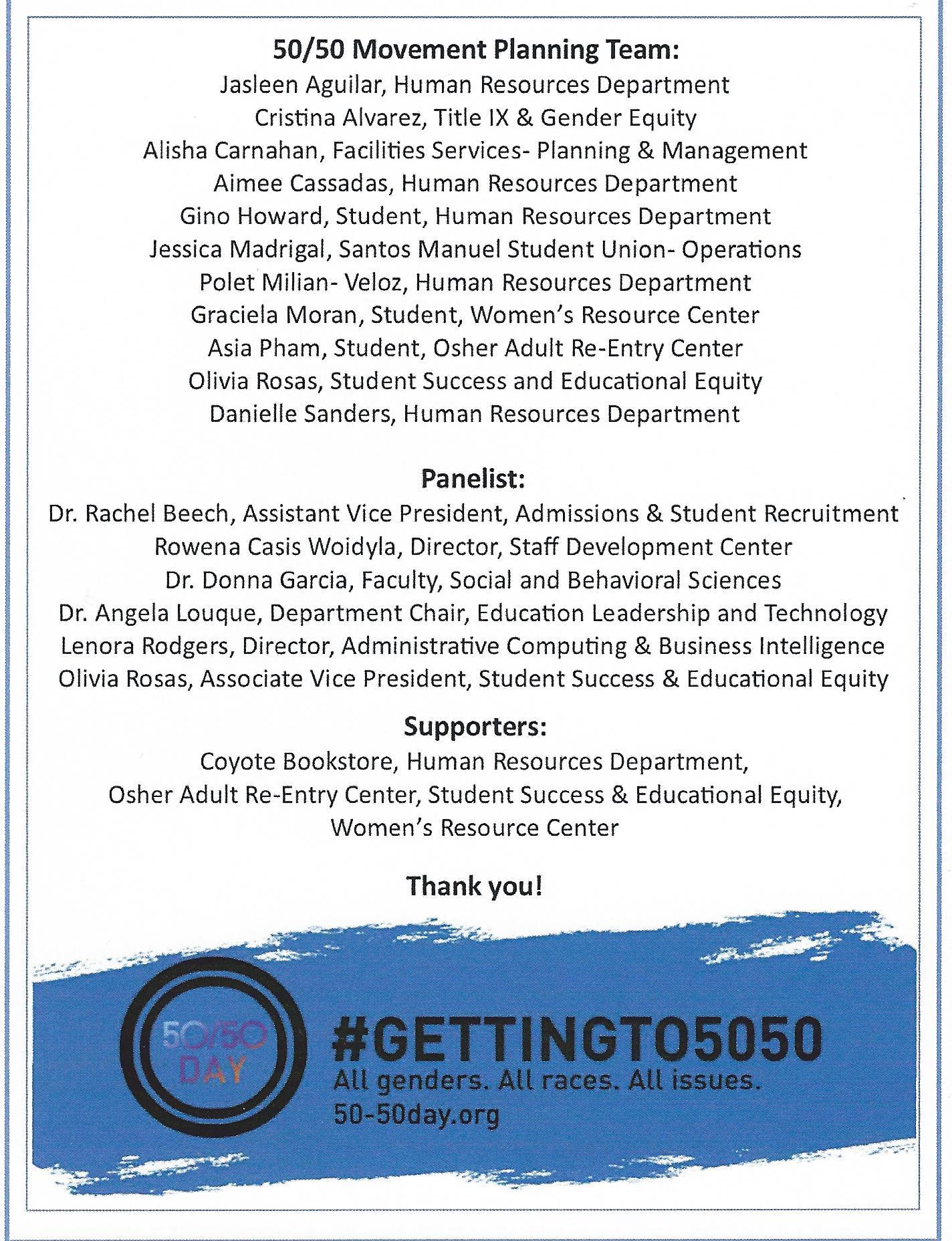
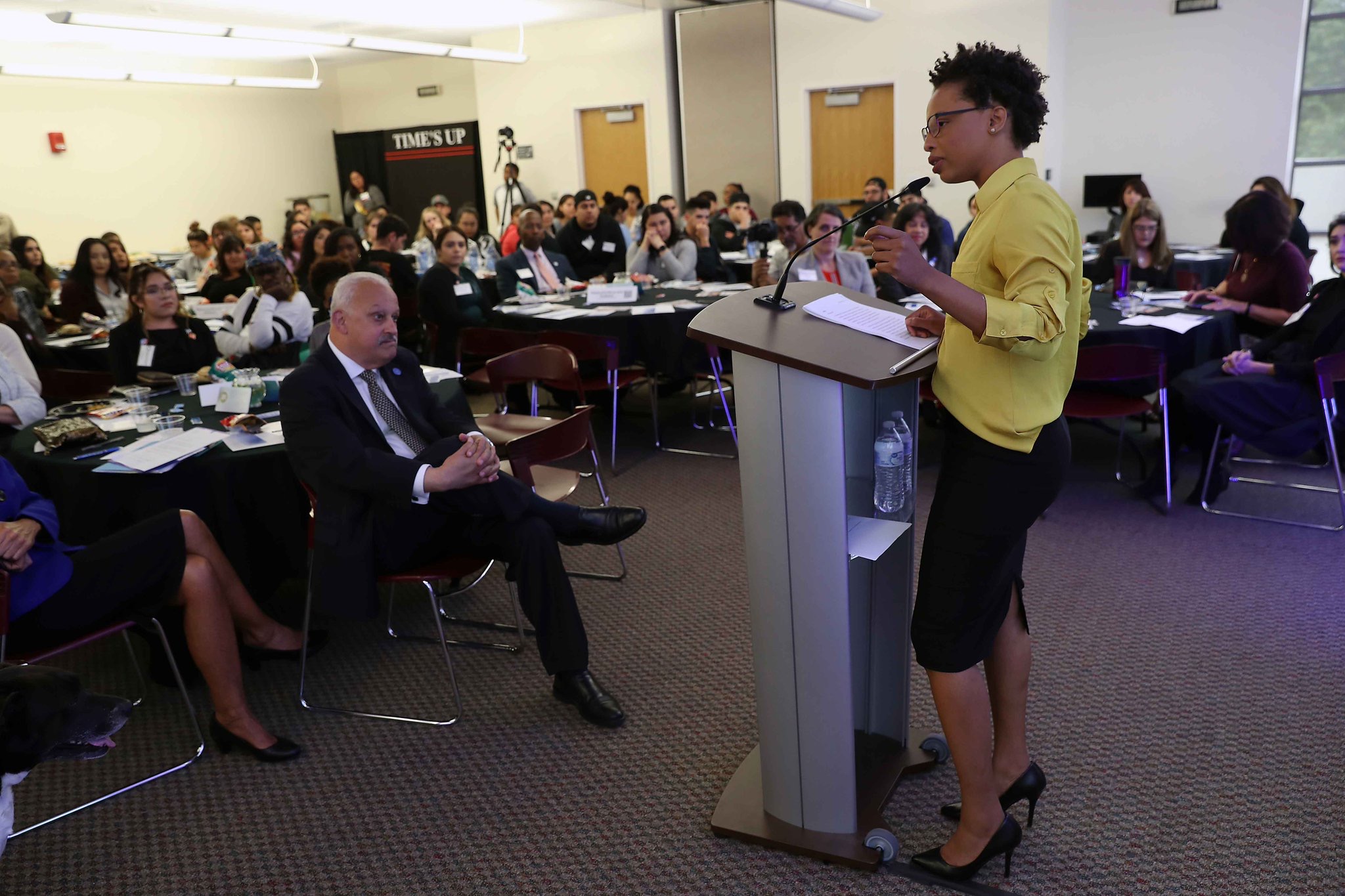
The event was a little late getting started, but the opening statements were heartfelt and it was clear the event was incredibly important to them. Asia Fam, one of the people responsible for putting the event together, introduced Dr. Shari McMahan, the first woman to hold her current position within the university. Then President Tomas Morales offered a breakdown of the gender statistics in and around CSUSB, followed by encouragement for students and women together. Graciela Moran, a member of the 50/50 committee and the woman’s resource center, then introduced the featured speaker, Monica Stockhausen.

Monica Stockhausen is the CEO of Nerdy Girls Rock, which encourages women to thrive in the business world. Stockhausen, a previous student at CSUSB, offered a simple, truthful speech that had everyone in the room applauding and nodding along. She was blunt and she was emotional. The committee did a truly wonderful job obtaining her as a speaker for this event. Everyone in attendance was fully engaged in listening and the conversations were all in agreement.

The event was in honor of the ongoing struggle to reach equality for all genders, races, and ages, with the majority in attendance being women. In this crowd, she asked everyone to recognize their own privilege. Her speech was moving and her requests eye-opening. In a crowd that was gathered to recognize their struggle, they ended up recognizing their own privilege. That is the type of understanding the event was designed to encourage, and that is the type of understanding I walked away with that day.

Parts of the event were a little lacking. I was not the only one questioning where to go to reach the event center. I was not the only one who had not realized they would be serving food; the only mention was in the subject line of a single email. I was not the only one seemingly underdressed in a room full of power-suits. Despite these shortcoming, the event was truly successful. A substantial group of men were in attendance for an event that, on the surface, largely appeared to be directed at women. The event room was packed full of attendees and they were all engaged in the material, in the speakers, in the conversations. Their second annual 50/50 Day celebration was a success, and I for one, look forward to attending their third annual celebration next year.

For more information on the 50/50 Movement or Monica Stockhausen:

Posted in Reading Response

Mind-Body Techniques

Research Blog #2: “Use of Treatment and Counseling Services and Mind-Body Techniques by Students with Emotional and Behavioral Difficulties”

Wasantha Jayawardene, Ryan Erbe, David Lohrmann, and Mohammad Torabi worked together to produce a peer reviewed research article entitled “Use of Treatment and Counseling Services and Mind-Body Techniques by Students with Emotional and Behavioral Difficulties.” Their proclaimed motivation was to study how treatment and counseling services from schools affected the use of mind-body techniques in students with difficulties based on the notion that MBTs can improve children’s health and wellness. All of the findings were based on National Health Interview Survey data. The article came to an interesting conclusion after studying not only the use of treatment and counseling services as well as mind-body techniques, but also the correlation with family-level factors.

The research found that mind-body techniques were more likely to be used in students with emotional and behavioral difficulties in 2007 than in 2012, demonstrating a decrease of its usage. Gender showed a significant difference as girls were much more likely to utilize mind-body techniques than boys. The use of mind-body techniques also increased based on a family with higher educated parents or a member with a limitation. Finally, school only treatment and counselling services were less likely to use mind-body techniques than nonschool only services.

These conclusions are interesting because it suggests that there is truly a stigma involved. An increasing number of school-aged people are experiencing emotional or behavioral difficulties, yet this research indicates that schools are less likely to utilize mind-body techniques, which have been proven to help, than other outside institutions. This is troubling because not only do students spend a vast majority of their days at school, leaving schools with a responsibility to properly care for all factors of their well-being, but their families may be dependent on school assistance to care for their kids.

As a research article in the public sphere, the authors presented their findings as objectively as possible, even sighting the limitations of their results. They detail all the aspects of their work and findings and present it in a logical format. The article was accepted in less than a year, effectively working its way through the public sphere of academia. It is a strong, well-presented article.

It is the information within that is cause for concern to me. Schools hold a responsibility to protect and care for their students. That includes caring for their well-being, mental or otherwise. Mind-body techniques have been shown to work, yet the schools show a tendency to avoid using them. Rather than simply avoiding the hassle, schools should be striving to battle the stigma surrounding the use of mind-body techniques. They are helpful for everyone. It is not something just for girls or those rich families; mind-body techniques are useful way to treat emotional and behavioral difficulties without resorting to medications.

Public schools are equalizers. The economic status of a child’s family plays very little part in the day to day activities within the schools. If schools were to introduce mind-body techniques to all of their grade levels, everyone would be able to get access to help and the stigma would slowly dissolve as more students were exposed to it. The difference between mind-body technique usage would no longer be as vast between parents with higher education and without, or between families with or without a member with limitations. All genders would be exposed to helpful techniques that could help them balance their well-being. This article shows that public schools ought to step up their game and begin introducing mind-body techniques into their treatment and counseling services and, ideally, to their student body as a whole.


Posted in Research Journal

Start the Conversation: Mental Health Matters

Research Journal #1

Middle and High School is a time of immense change. Aside from no more recess, the biggest changes happen from within. And a little without. Bodies are changing, and with that emotions and expectations. Suddenly it isn’t enough to get AR points and have a good group of friends to play tag with at recess. Now you have to get used to multiple teachers, multiple groups of classmates, and increased expectations for success in schools. The teachers don’t seem to care that you have other classes, assigning homework like you have all the time in the world to focus on this one assignment. You can get enough sleep, fulfill all your responsibilities at school and home, or have a social life, but you can’t have all three. Your hormones are going crazy, giving you mood swings like you wouldn’t believe and muddling everything in your head so it is impossible to gain perspective. And the breaks never come.

Sure, schools give you a Monday off here or there. You get a week at Thanksgiving, two at Christmas, another for Spring. But those aren’t really true rest periods, are they? Your entire break is spent working on projects from your teachers you suddenly have time for, meeting all the family expectations-since it is family time, after all- and maybe, if you get lucky, squeezing in an hour with your best friend. For seven years, the cycle is never ending, expectations only getting bigger and social pressure growing stronger. And it doesn’t end there; suddenly you’re in college and facing even more, or maybe you didn’t make it to college and now have to face finding a job degree-less.

With all of that pressure and no time to actually release any of it, it is no wonder that an increasing number of people are suffering from mental health issues. Anxiety, ADHD, depression, eating disorders, and PTSD- just to name a few- are all added weights that make functioning a daily struggle for so many. Unfortunately, unlike the amount of homework heaped on kids, very few actually acknowledge the existence of mental health as a common obstacle that needs to be addressed. Instead, mental health is treated like a taboo subject: only the “odd-balls” suffer from mental health issues. The cool kids? The top 10? They are above mental health issues.

It is this kind of thinking that makes mental health issues so dangerous. When the fear of being judged outweighs the benefits of getting help, mental health issues go unchecked and leave our kids vulnerable. When your own mind is acting against you, and you have no one to help you be objective, what is there to stop you from doing something drastic?

If we can be the voice of perspective for our kids when it comes to being upset over fights with their friends, why can’t we be that voice when it comes to their minds?

That is why openly acknowledging the importance of a mental health is so important to me. Kids are forced to quietly struggle every single day of their lives instead of seeking help at the sources meant to be available to them. By staying quiet about mental health, by not encouraging questions and discussions, we make mental health unimportant. Instead of silencing our kids, we should be encouraging them to be vocal. Talk to them about mental health. Educate them on what is okay and what isn’t. Make it okay for them to talk about it with their parents, or their friends, or people that can help them.

If someone had told me that not everyone faced my struggles every single day, that I didn’t need to face my struggles every single day? I can’t even imagine what my life would have been like if I had known. I probably would have been able to ask for help before I broke down sobbing, gasping for breath, unable to explain to myself or my parents why I was suddenly about to pass out from facing them in our own home.

Don’t let mental health be a quiet killer. Talk about it. Make it okay. Teach our kids how to balance themselves, how to protect themselves. Let them know it’s okay to ask for help. Not everyone suffers from mental health issues, but it isn’t worth the sensibilities of a few to silence the struggles of the many.

For further conversations:

Posted in Reading Response

Are We Overmedicating Our Children?

Research Blog #1: “CDC: One in 13 Children Taking Psych Meds”

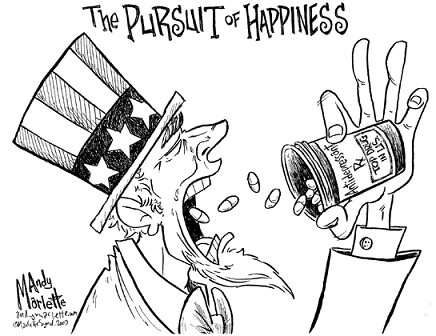
The New American published an article entitled “CDC: One in 13 Children Taking Psych Meds.” In this article, the argument is made that not only are an increasing number of children in the United States being prescribed psychiatric medication, but a substantial number of those children are being improperly medicated.

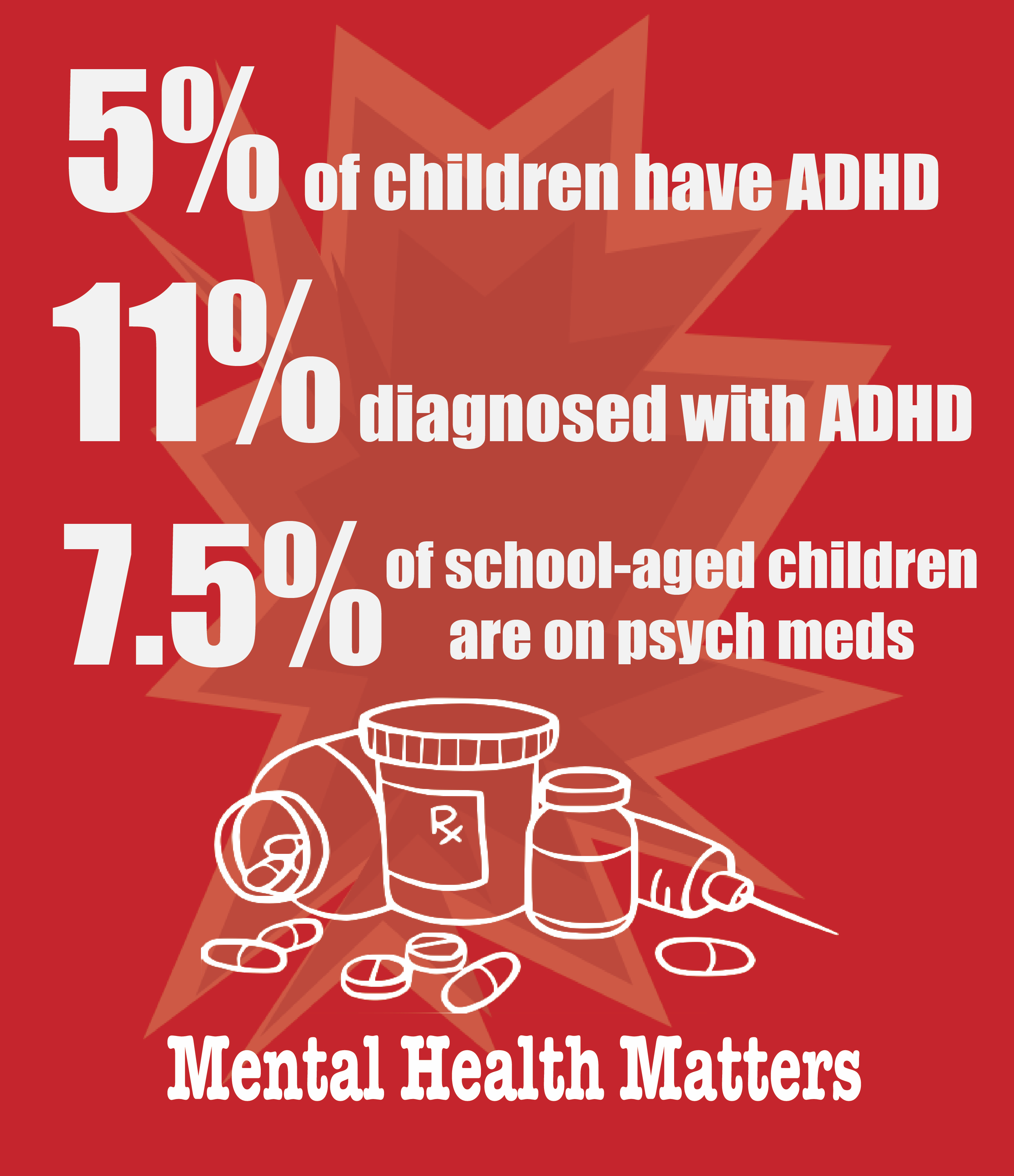
The article uses data from the Centers for Disease Control as the basis for their claim that the number of children medicated is growing. According to the article and the referenced data, in 2014, “7.5 percent of children between the ages of six and seventeen” were on psychiatric medication, which is a clear and substantial increase in prescriptions from the previous two decades.

The American Psychiatric Association then provides the data for the articles second claim, which is that children in the United States are being improperly diagnosed and therefore overmedicated. The Association released the information that “five percent of American children have ADHD, but studies reveal more than 11 percent of American children are diagnosed with the condition.”

The article may be short, but it makes hugely concerning claims. The article itself is fairly focused in on ADHD as a so-called epidemic being blown out of proportion and vastly overdiagnosed. However, it hints at larger concerns. If the statistics for diagnosis and prescriptions are so out of proportion for this one issue, how accurate are other diagnosis for similar cases? Is ADHD that difficult to diagnose, or is this article and referenced data revealing a larger issue amongst the prescription and use of psychiatric medications?

The article itself makes a decent, qualified argument. As it is a work intended for the public sphere, it is careful to make its point clear without casting too much doubt and clouding its argument. The data referenced is not embellished and the interpretations by the article’s author includes qualifications that acknowledge the limits of the data. The article remains largely objective, referencing statistics from reliable, well-known sources for the basis of the article. The claim comes from yet another source intended to come across as reliable, leaving the author of the article seemingly objective and just stating the facts. Overall, the article’s claim and reasoning are strong, leaving just hints that the issue could be wider than the provided data specifically states.

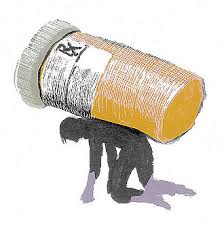
The possible number of incorrect diagnosis for our school-aged children is a concerning concept. The overuse of psychiatric medication is even more so. The United States seems to be suffering from a too large reliance on medications. People are becoming reliant on various little pills and syrups to solve their issues without stopping to consider what it is they are injecting into their bodies. The thought that these medications are being offered to children incorrectly makes the problem even more apparent. The medications prescribed can often have lasting effects even when used properly. Dosing our kids up based on quick and inaccurate judgements can have vast and lasting repercussions that so many people fail to consider, leading to data such as that referenced in the article. It is a frightening concept. Our kids don’t need to be drugged to the gills because they’re having a bad day; they need to be taught how to properly care for themselves and others.  We need to enable our children, not hinder them with wrongly prescribed drugs.